

For millions of South Africans, their homes, farms, and shops do not exist online. Specifically, they do not appear on maps, listing sites, or search results. Although these properties are real and valuable, they remain invisible to the digital world.
Consequently, this is not just a minor issue; it is a major barrier to financial growth.
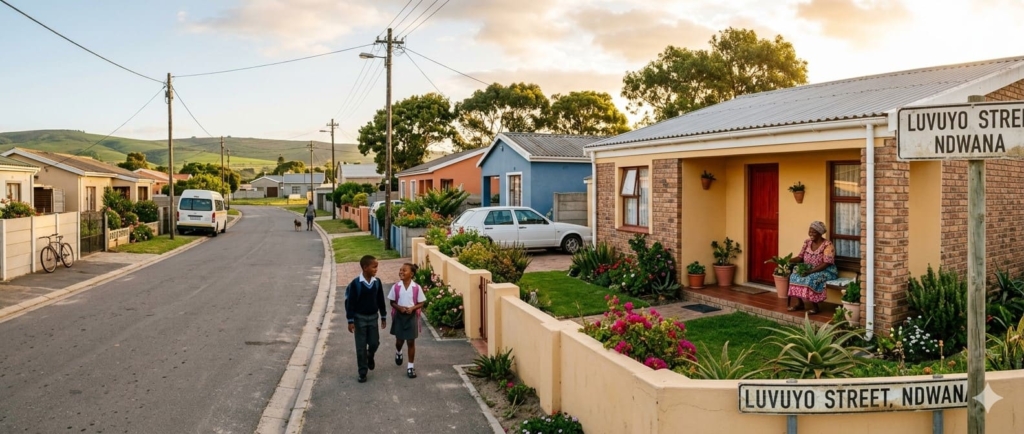
Two Forms of Exclusion, One Root Cause
South Africa often discusses financial inclusion—the ability to access bank accounts, credit, and insurance. However, a related issue exists: digital inclusion for property.
If a property lacks an online footprint, owners find it harder to value, finance, and sell at a fair price. Today, banks, appraisers, and buyers search online first. If a property never appears in a listing, it rarely gains attention. Furthermore, people often undervalue what they cannot see.
This is where these two problems meet. A recent investigation by the Competition Commission found that high fees on major property websites prevent many people from getting online. As a result, this affects agents and owners in historically disadvantaged areas, who cannot afford the same “digital shelf space” as others.
The result is clear: wealthy suburbs enjoy full online visibility. Meanwhile, townships and smallholdings rely on word-of-mouth or social media posts that disappear within 48 hours.
Why Digital Visibility Is an Economic Issue, Not Just a Tech One
When a property stays offline, the consequences are serious:
- Difficult valuations: There is little sales data for comparisons.
- Hard-to-get loans: Banks require clear market data to approve financing.
- Limited demand: Buyers outside the local community cannot find the property.
- Lost value: Listings trapped in temporary social media posts lack a lasting record.
Ultimately, this creates a hidden tax on wealth-building in communities that can least afford it. Property is a powerful tool for building family wealth. When a system keeps a property hidden, it suppresses the asset’s potential—not because the property lacks value, but because the system denies it a fair chance to be visible.
What a Digital Presence Changes
Giving a property a permanent, searchable listing changes everything. Above all, it puts that property on the map, both literally and figuratively.
A digital presence provides:
- A permanent record: It does not vanish like a social media post.
- Easy discovery: Buyers and banks can find it at any time.
- Fair pricing: It creates a starting point for price negotiations.
- Dignity: Every homeowner deserves the same professional online presence, whether they own a mansion or a modest starter home.
This is why we created Prop Listing. Our model costs just R99 for 35 days. We are not a cheaper version of big platforms; instead, we provide a low-cost tool to ensure that high fees never prevent a property from entering the digital economy.
Inclusion Has to Be Designed, Not Assumed
Markets do not become inclusive by accident. Left alone, high costs decide which properties get noticed. In fact, this often reinforces the same unfair patterns South Africa has worked for decades to fix.
We must build digital inclusion on purpose. We need affordable access and simple tools that treat every home—from a small plot in Polokwane to a house in Soweto—with the same respect as a luxury home in Sandton.
That is the gap Prop Listing aims to bridge. Every time a property receives its first digital presence, we help it become easier to value, finance, and sell. Finally, this is one more step toward a property market that represents the whole country, not just those who could always afford to be seen.
Does your property need an online presence? List it on Prop Listing today for R99 and give it the digital presence it deserves.
